No items yet.
Browse services or products and click Inquire.
The ancient Ayurvedic practice of continuous warm oil flow, and why it may be the most powerful tool for modern stress.
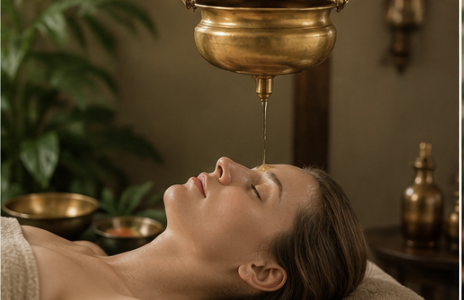
You lie back on a low wooden table, the room warm and quiet, scented with something herbal and ancient. A brass vessel hangs suspended above your forehead. Then it begins, a thread of warm oil touches the center of your brow, and something inside you releases that you did not know you were holding. The thinking stops. Not because you forced it to, but because the nervous system, finally, has been given permission to be still. The oil continues in its slow, pendulous sweep across the forehead. Time becomes irrelevant. What remains is something close to silence, not the absence of sound, but the absence of agitation.
This is Shirodhara. And while it is easy to describe in sensory terms, what is actually happening beneath the surface, neurologically, physiologically, energetically, is far more extraordinary than the experience alone would suggest.
"Shiro" means head. "Dhara" means continuous stream or flow. Together, the word describes exactly what the treatment does: a sustained, unbroken flow of warm medicated oil poured directly onto the forehead. In classical Ayurveda, this treatment is documented in both the Charaka Samhita and the Ashtanga Hridayam, two of the foundational texts of the tradition, composed over 2,000 years ago. Shirodhara was prescribed for anxiety, insomnia, hypertension, neurological disorders, migraines and certain forms of mental illness. That it has survived, largely unchanged, into the 21st century, and is now attracting the attention of neurological researchers, is not a matter of cultural sentimentality. It is a testament to genuine, observable efficacy.
In a tradition that has seen countless practices rise and fall with changing fashions, the ones that remain are the ones that work. Shirodhara has endured because what it does to the human nervous system is real, measurable and remarkably consistent across individuals, constitutions and cultures.
A client lies comfortably on a wooden droni, the traditional Ayurvedic treatment table, designed with a channel for the oil to flow during treatment. The head is carefully positioned beneath a suspended brass vessel called the dhara patra. The herbal oil inside has been heated to precisely body temperature: warm enough to penetrate the scalp, gentle enough to feel like it belongs there.
The oil begins to flow in a steady, unbroken stream onto the forehead at the point known in yoga as the ajna chakra, the third eye center, located at the space between and slightly above the eyebrows. The stream follows a gentle pendulum motion, moving slowly back and forth across the forehead in a continuous, unhurried arc. Nothing is rushed. The session lasts between 30 and 45 minutes, depending on the individual's constitution and the condition being addressed.
Afterward, the oil is allowed to rest on the scalp for a period of quiet repose before a gentle cleansing. Many clients do not realize until afterward that they have entered a state between waking and sleep, a meditative half-consciousness that most describe as unlike anything they have experienced before. The eyes are typically closed. The body becomes very heavy, very still. The mind, so accustomed to its own noise, goes quiet.
In Ayurveda, the oil used in Shirodhara is never arbitrary, it is selected with precision based on each individual client's dosha constitution, the season, and the nature of the imbalance being addressed. This is one of the aspects of the treatment that most distinguishes an authentic Ayurvedic Shirodhara from a spa approximation.
For Vata imbalance, presenting as anxiety, racing thoughts, insomnia, nervous system dysregulation, or fear, a warm sesame-based oil is generally used as the carrier, often infused with deeply nourishing herbs such as ashwagandha, brahmi (Bacopa monnieri) or bala. These herbs have a grounding, fortifying effect on the nervous system and are particularly indicated for depletion.
For Pitta imbalance, presenting as chronic inflammation, irritability, migraines with heat, or mental intensity that has crossed into burnout, a cooling coconut or sunflower oil base is preferred, often infused with bhringaraj, amalaki or rose. The cooling action is not merely metaphorical; these oils demonstrably reduce scalp and head heat.
For mixed or Kapha presentations, lighter oil bases are used, often carrying stimulating herbs that gently activate rather than sedate. A thorough consultation always precedes the treatment, because in Shirodhara, the selection of oil is not preparation for the medicine. It is half the medicine itself.
Contemporary research into Shirodhara has begun to illuminate what traditional practitioners have observed for millennia. The continuous, rhythmic tactile stimulation of the forehead appears to activate the parasympathetic branch of the autonomic nervous system, reducing circulating levels of cortisol and adrenaline while promoting the release of serotonin and dopamine. Electroencephalographic studies have recorded the emergence of theta brainwave states during Shirodhara sessions, the same slow, deeply relaxed waves that arise during deep meditation and the transitional state between waking and sleep. The forehead skin is particularly rich in mechanoreceptors connected via cranial and peripheral nerve pathways to the vagus nerve, the body's primary parasympathetic highway. The sustained warmth of the oil adds a layer of thermoreceptor stimulation that deepens the effect. What results is a kind of double activation of the body's quieting system: simultaneously through touch and through heat, at one of the most neurologically sensitive points on the entire body's surface. No pharmaceutical intervention achieves this quality of quieting without side effects. Shirodhara does it without a single one.
In clinical Ayurvedic practice, Shirodhara is indicated for a wide range of conditions where the nervous system is centrally involved. The following presentations consistently respond well to a course of treatment:
It is equally important to note the contraindications. Shirodhara is not appropriate for clients with active fever, open wounds or active infection on the scalp, recent head trauma (within three months), or during the third trimester of pregnancy. Those with certain skin conditions affecting the forehead should also be assessed carefully. A prior consultation with Vaidya Falguni is always required before scheduling this treatment, not as a formality, but because appropriateness and oil selection genuinely determine the outcome.
On the day of your Shirodhara treatment, rest is not merely recommended, it is part of the therapy. The nervous system has entered a profound state of reorganization, and that process deserves quiet completion. Avoid screens, loud environments, demanding social situations, and stimulating physical activity for the remainder of the day. Eat lightly, warmly, and without distraction. Allow yourself to go to bed early.
Many clients report that the night following their first Shirodhara session brings the deepest, most unbroken sleep they have experienced in years. This is not coincidence. The treatment has done what no supplement can fully replicate: it has told the nervous system, at a level below conscious control, that it is safe to rest.
Over a full course of treatments, traditionally 7 to 14 consecutive days within a Panchakarma program, or weekly sessions over 4 to 6 weeks for outpatient work, the cumulative benefits deepen considerably. Anxiety levels that seemed fixed begin to shift. Sleep architecture normalizes. Migraines that have been managed with medication begin to lose their frequency and intensity. Clients often describe a sense of returning to themselves, a clarity and groundedness that they had forgotten was possible.
Shirodhara is a treatment that rewards consistency. A single session offers genuine relief; a complete course of treatment offers transformation. If you have lived for years in a state of chronic stress, overactivation, or exhaustion, this is not a luxury. It is medicine.
Every element of Shirodhara at vfayur, the oil selection, the temperature, the duration, the herbs, and the aftercare guidance, is calibrated to the individual receiving it. This is not a protocol applied uniformly. It is a conversation between an ancient practice and a specific living person. If you would like to understand whether Shirodhara is right for you, and how it might be adapted to your constitution and current needs, we invite you to reach out and begin that conversation.
A deeply individualized treatment. Your consultation ensures the right oils, the right duration, and the right preparation for your constitution.


.png)